top of page

Milestones
2026
We have four papers with KidsTeam UW accepted to CHI and two to IDC.
CHI 2026
Fusco, F., Pitt, C., Newman, M., Yip, J.C., & Soni, N. (2026). Towards understanding children’s collaborative interaction patterns in child-AI co-creative interfaces. In Proceedings of the 2026 CHI Conference on Human Factors in Computing Systems.
https://doi.org/10.1145/3772318.3791831
[h5-index – 139][PDF]
Newman, M., Yoo, D., Zhao, R., Tuy, E., Yi, H., Kim, D., Lee, J.H., & Yip, J.C. (2026). Pringles, Prangles, or Prongles? Negotiating creative authorship in children’s remix practices. In Proceedings of the 2026 CHI Conference on Human Factors in Computing Systems.
https://doi.org/10.1145/3772318.3791311
[h5-index – 139][PDF]
Yip, J.C., Newman, M., Zhao, R., Kim, D., Lim, J.R., Pedraja, M.K., Sachdeva, S., Zheng, X., Zhou, Y., Coward, C., & Lee, J.H. (2026). Rethinking misinformation: A holistic community model for youth resilience through socioemotional learning and sociocultural design. In Proceedings of the 2026 CHI Conference on Human Factors in Computing Systems.
https://doi.org/10.1145/3772318.3790876
[h5-index – 139][PDF]
Yoo, D., Newman, M., Pitt, C., Vo, K.H., Zhang, M., Kim, M., Davis, K., & Yip, J.C. (2026). Generative AI in children’s creative collaboration: Impact, perception, and design guidelines. In Proceedings of the 2026 CHI Conference on Human Factors in Computing Systems.
https://doi.org/10.1145/3772318.3790907
[h5-index – 139][PDF]
IDC 2026
Dangol, A., Wolfe, R., Devasia, N., Kiyohara, M., Yip, J.C., & Kientz, J. (2026). Where does AI leave a footprint? Children’s reasoning about AI’s environmental costs. In Proceedings of Interaction Design and Children.
[h5-index -35][PDF - coming soon]
Dangol, A., Gupta, M., Yoo, D., Wolfe, R., Yip, J.C., Roesner, F., & Kientz, J. (2026). Toys that listen, talk, and play: Understanding children's sensemaking and interactions with AI toys. In Proceedings of Interaction Design and Children.
[h5-index -35][PDF]
2025
We celebrated KidsTeam's 10th anniversary!
We got one paper at CHI 2025 and one at IDC 2025 with KidsTeam UW work.
CHI 2025
Hunt, C.L., Sun, K., Dhuliawala, Z., Tsukiyama, F., Druin, A., Huynh, A., Leithinger, D., & Yip, J.C. (2025). Children using tabletop telepresence robots for collaboration: A longitudinal case study of hybrid and online intergenerational participatory design. In Proceedings of the 2025 CHI Conference on Human Factors in Computing Systems. https://doi.org/10.1145/3706598.3713746
[h5-index - 129] [PDF]
IDC 2025
Dangol, A., Zhao, R., Wolfe, R., Ramanan, T., Kientz, J.A., & Yip, J. (2025). AI just keeps guessing”: Using ARC puzzles to help children identify reasoning errors in generative AI. “In Proceedings of 2025 Conference on Interaction Design and Children (IDC 2025). https://doi.org/10.1145/3713043.3728836
[h5-index - 33][PDF]
2024
We got a Best Paper Honorable Mention at CHI for a KidsTeam UW paper on AI. The lab got $75k of funding from Spencer Foundation to do work in AI.
CHI 2024
Newman, M., Sun, K., Gasperina, I.D., Pedraja, M., Kanchi, R., Song, M.B., Li, R., Lee, J.H., & Yip, J.C. (2024). “I want it to talk like Darth Vader”: Helping children construct creative self-efficacy with generative AI. In Proceedings of the 2024 CHI Conference on Human Factors in Computing Systems.
[h5-index – 122] [PDF]
***HONORABLE MENTION Best Paper Award (Top 5% of 4,000+ submissions)***🥇
2023
KidsTeam was given $5,000 from Amazon and an award of $2,150,688 to foster joint peer-to-peer engagement, promote engineering learning, and expand reach to young children from the National Science Foundation.
2022
KidsTeam was given gift funds from Sony Interactive Entertainment, Amazon, and Duolingo for $8,000, $8,000, and $4,000. Additionally, the UW iSchool gave $18,480 to the lab in order to research perceptions of risk in safety platforms, and the Institute of Museum and Library Services gave $249,917 to combat mis/disinformation.
We won Best Paper at International Journal of Child-Computer Interaction.
Fails, J.A., Ratakonda, D.K., Koren, N., Elsayed-Ali, S., Bonsignore, E., & Yip, J.C. (2022). Pushing boundaries of co-design by going online: Lessons learned and reflections from three perspectives. International Journal of Child-Computer Interaction.
***BEST PAPER AWARD 2023 (TOP 2%)*** 🏆︎
[PDF – Full paper]
2021
We were given an Honorable Mention Best Paper for Designing Interactive Systems, a Top Paper Award for International Communications Association for Games Studies, and Best Paper at CHI for Computing Systems.
DIS 2021
Roldan, W., Li, Z., Gao, X., Kay Strickler, S., Hishikawa, A.M., Froehlich, J. E., & Yip, J. (2021). Pedagogical Strategies for Reflection in Project-based HCI Education with End Users. Proceedings of Designing Interactive Systems 2021.
[h5-index – 31, Acceptance rate – 24%]
**HONORABLE MENTION BEST PAPER AWARD (TOP 5% out of 400+ submissions)**🥇
[PDF – Full paper]
CHI 2021
Lee, K.J., Roldan, W., Zhu, T.Q., Saluja, H.K., Na, S., Chin, B., Zeng, Y., Lee, J.H., & Yip, J.C., (2021). The show must go on: A conceptual model of conducting synchronous participatory design with children online. In Proceedings of the 2021 CHI Conference on Human Factors in Computing Systems. Association for Computing Machinery.
[h5-index – 95, Acceptance rate – 26.3%]
**BEST PAPER (TOP 1% out of 2,800 submissions)**🏆︎
[PDF – Full Paper]
Amazon and the Sesame Workshop gave gift funds of $24,000 and $2,000 respectively. The Canadian Institute for Advanced Research and Jacobs foundation gave $40,125 to research socioeconomic disparities in education. The Jacobs foundation also gave $11 million for the CERES Research Network.
2020
We got an Honorable Mention at CHI for a paper on Human Factors in Computing Systems.
CHI 2020
Roldan, W., Gao, X., Hishikawa, A.M., Ku, T., Li, Z., Zhang, E., Froehlich, J., & Yip, J.C. (2020). Opportunities and challenges in involving users in project-based HCI education. In Proceedings of ACM SIGCHI Human Factors in Computing Systems (CHI 2020).
[h5-index – 87, Acceptance rate – 24.31%]
***HONORABLE MENTION BEST PAPER (TOP 5% out of 3,100 submissions)***🥇
[PDF – Full paper]
Amazon gave a $16,000 gift fund to KidsTeam. The National Science Foundation donated $124,584 to understand family life and the role of technology in the context of COVID-19 and $594,046 to design for Youth Invisible work in Families. Research about E-Sports and Wellness in Youth was given $783,007 by Pivotal Ventures. KidsTeam was awarded $169,616 to research new technology for children and families.
2019
KidsTeam got a gift fund from Amazon for $32,000. The National Institute of Health awarded $465,794 to Pilot Mobile-Wearing Just-In-Time Adaptive Intervention for Sun Safety Among Children.
2018
We were awarded an Honorable Mention at CHI and an Honorable Mention for a seperate paper on Computer Supported Collaborative work. The Institute of Museum and Library Services donated $89,109 to research VR stories and art in Libraries and Museums as assets for Juvenile Rehabilitation. Research on Participatory Action for Parenting in the Digital Age was co-funded by the Jacobs Foundation and the Society of Research on Child Development for $15,000. $353,071 was given to KidsTeam by the Institute of Museum and Library Services to support Intergenerational Participatory Design Groups in Design Thinking Around Digital Learning.
2017
We were given a Best Paper Honorable Mention at CHI and had the Most Interesting Preliminary Results Paper at iConference. Mozilla gave $67,572 to research Design Opportunities for In-Home Digital Assistants for Low- and Middle- Income Families.
2016
Google awarded us $15,000 to study Indigenous Knowledge Informatics and Native Girls in the STEM Pipeline. KidsTeam was given $5,000 to support Community Partnerships with Organizations. UW also gave $39,994 for research into Latino Youth Searching and Brokering Online Information for their Families. Seattle Public Libraries gave an $8,000 gift fund. The iSchool gave us $15,000 to study Design Thinking and Digital Games in Libraries and $22,500 to develop a Libraries and Librarians Course Development.
2015
KidsTeam was given $64,500 from Google to research Youth Searching and Brokering Online Information for Latino Families with Limited English Proficiency.
2014
We were given a Best Student Paper Award Nomination at the International Conference of the Learning Sciences. The National Science Foundation also gave $1.35 million for ScienceKit for ScienceEverywhere, a Seamless Scientizing Ecosystem for Raising Scientifically-Minded Children.
2013
One of our papers won the Best Social Media Expo Award at the iConference. Sesame Workshop gave $50,000 to KidsTeam.
2011
The National Science Foundation gave us a seed grant of $6,000 to develop video games for science museums.
Archived Designs
Science Everywhere
Years: 2015 - 2019
Main Collaborators: June Ahn, Tamara Clegg, Elizabeth Bonsignore, Kelly Mills, Caroline Pitt, Daniel Pauw
Description: Science Everywhere is an NSF funded research study aimed at understanding how technology can engage entire communities in science learning. We utilize a design-based research approach in which we co-design innovative science learning technology with families, teachers, and leaders in a community, implement that technology in the community, and then redesign that technology in an iterative design process. Broadly, this study will contribute to theory on connected learning by developing an understanding of how to connect science learning at home, school, and community spaces with technology. This study also aims to contribute to our understanding of parent-child learning, interactive display design, and social media for learning.
Videos:
Representative Papers:
Ahn, J., Clegg, T., Yip, J.C., Bonsignore, E., Pauw, D., Gubbels, M., Lewittes, B., & Rhodes, E. (2015). Seeing the unseen learner: Designing and using social media to recognize children’s science dispositions in action. Learning, Media, and Technology.
Ahn, J., Clegg, T., Yip, J., Bonsignore, E., Pauw, D., Cabrera, L., Hernly, K., Pitt, C., Mills, K., Salazar, A., Griffing, D., Rick, J., & Marr, R. (2018). Science Everywhere: Designing public, tangible displays to connect youth learning across settings. In Proceedings of SIGCHI Human Factors in Computing Systems (CHI 2018). New York, NY: ACM.
*Note: First authors are listed by alphabetical order (Ahn, Clegg, Yip).
Clegg, T., Hernly, K., Ahn, J., Yip, J., Bonsignore, E., Pauw, D., & Pitt, C. (2023). It takes a village: Relational dispositions that fuel community science learning. American Educational Research Journal.
Mills, K., Bonsignore, E., Clegg, T., Ahn, J., Yip, J., Pauw, D., Hernly, K., & Pitt, C. (2019). Connecting children’s scientific funds of knowledge shared on social media to science concepts. International Journal of Child-Computer Interaction.
Mills, K., Bonsignore, E., Clegg, T., Ahn, J., Yip, J., Pauw, D., Cabrera, L., Hernly, K., & Pitt, C. (2018). Designing to illuminate children’s scientific funds of knowledge through social media sharing. In Proceedings of ACM Interaction Design and Children.
BlockStudio
Years: 2015 - 2018
Main Collaborators: Rahul Banerjee, Amy Ko, Zoran Popovic
Description: BlockStudio is a research initiative developed jointly by the Center for Game Science and the Information School at the University of Washington, aimed at making introductory computer programming accessible to English Language Learning immigrant families. The project partners with community centers serving immigrant populations to host family night coding sessions where families speaking diverse languages can learn to program together. BlockStudio employs two core design principles: eliminating all text from the programming interface and avoiding abstract programming concepts, replacing them with a fully visual language built around concrete notions like colored shapes. During family sessions across three community centers, all participating families demonstrated Joint Media Engagement, collaboratively discussing and implementing ideas, with some producing complex creations involving multiple game mechanics. The study advances knowledge on family-oriented learning and child-led intergenerational technology education.
Representative Papers:
Banerjee, R., Liu, L., Sobel, K., Pitt, C., Lee, K.J., Wang, M., Chen, S., Davison, L., Yip, J., Ko, A., & Popovič, Z. (2018). Empowering families facing English literacy challenges to jointly engage in computer programming. In Proceedings of SIGCHI Human Factors in Computing Systems (CHI 2018). New York, NY: ACM.
**HONORABLE MENTION BEST PAPER (TOP 5% out of 2,500 submissions)**
Banerjee, R., Yip, J.C., Lee, K.J., and Popović, Z. (2016). Empowering children to rapidly author games and animations without writing code. In Proceedings of the The 15th International Conference on Interaction Design and Children (IDC ’16), 230–237.
AI Puzzlers
Years: 2025 - 2026
Main Collaborators: Aayushi Dangol, Robert Wolfe, Daeun Yoo, Arya Thiruvillakkat, Ben Chickadel, Julie Kientz, Runhua Zhao, Trushaa Ramanan
Description: Generative AI is increasingly embedded in children's digital lives, raising important questions about how these technologies affect children's problem-solving and creative development. To explore these questions, we began by listening to children, who described wanting to use AI as an advisor, collaborator, and task manager, while also expressing fears that over-reliance on AI could weaken their own learning and reasoning skills. Building on these insights, the team co-designed with children around visual puzzles that AI still struggles with, to give children hands-on experiences examining how AI works and where it falls short. These experiences helped children see AI outputs as something they could question, probe, and reshape, building richer mental models of AI's capabilities. This research contributes to understanding how to nurture children's curiosity about AI while fostering critical thinking, persistence through uncertainty, and creative problem-solving.
Read about our design process here.
Representative Papers:
Dangol, A., Wolfe, R., Yoo, D., Thiruvillakkat, A., Chickadel, B., & Kientz, J. A. (2025). If anybody finds out you are in BIG TROUBLE”: Understanding Children’s Hopes, Fears, and Evaluations of Generative AI. In Proceedings of the 24th Interaction Design and Children.
Dangol, A., Zhao, R., Wolfe, R., Ramanan, T., Kientz, J. A., & Yip, J. (2025). “AI just keeps guessing”: Using ARC Puzzles to Help Children Identify Reasoning Errors in Generative AI. In Proceedings of the 24th Interaction Design and Children.
Telepresence Robots for Co-Design
Years: 2020 - 2024
Main Collaborators: Casey Hunt, Daniel Leithinger, Amanda Huynh, Allison Druin, Zahra Dhuliawala, Fumi Tsukiyama, Kaiwen Sun
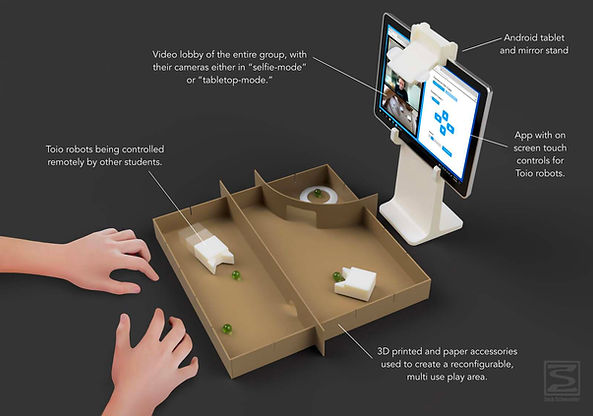
Description: Most studies in co-design (prior to COVID-19), focused on co-located in-person sessions that involved physical techniques. However, these physically proximal activities are not possible online. This lack of physical engagement creates barriers and leaves children feeling less creative and engaged in the remote co-design process. To workaround this situation in which children are co-designing online, we create another option for remote co-design: tangible interfaces for remote co-design. Our project, Together Apart, uses toio tabletop robots and a tablet interface to add a tangible dimension to online co-design. When using our system, our child design partners acted in an engaged manner not typically seen in remote settings. Children used our toio robotics system to design games, swarm robot expressions, and create physical art together. For our workshop contribution, we will showcase some of our work-in-progress and develop potential collaborations for tangible online co-design. In the future we plan to move from a fully remote environment to a hybrid environment for co-design.
Representative Papers:
Hunt, C.L., Sun, K., Dhuliawala, Z., Tsukiyama, F., Druin, A., Huynh, A., Leithinger, D., & Yip, J.C. (2025). Children using tabletop telepresence robots for collaboration: A longitudinal case study of hybrid and online intergenerational participatory design. In Proceedings of the 2025 CHI Conference on Human Factors in Computing Systems.
Hunt, C.L., Sun, K., Tseng, K., Balasubramaniyam, P., Druin, A., Huynh, A., Leithinger, D., & Yip, J.C. (2024). Making a metaphor sandwich: Analyzing children’s use of metaphor during tabletop telepresence robot supported participatory design. In Proceedings of the 2024 Conference on Interaction Design and Children.
Hunt, C.L., Sun, K., Dhuliawala, Z., Tsukiyama, F., Matkovic, I., Schwemier, Z., Wolf, A., Zhang, Z., Druin, A., Huynh, A., Leithinger, D., & Yip, J. (2023). Designing together, miles apart: A longitudinal tabletop telepresence adventure in online co-design with children. In ACM Interaction Design and Children.
Team Hamsters
Years: 2023 - 2025
Main Collaborators: Caroline Pitt, Jessica Andrews, Melissa Carlson, Anessa Roth
Description: Engineering education is critical for children navigating an increasingly technological world, yet many lack access to quality engineering instruction, and existing digital educational games often fall short in either engagement or educational value. Research on Joint Media Engagement has shown that children's learning from educational media is enhanced when they engage jointly with others, but most JME studies focus on parent-child interactions, leaving peer-to-peer and sibling learning largely unexplored. To address these gaps, media producers from GBH and our team co-designed and tested digital peer-to-peer engineering games based on the PBS KIDS series Team Hamster!, intended for 5- to 7-year-olds playing together on the same device in informal settings. Over an 18-month period, we conducted 36 co-design sessions with KidsTeam UW, KidsTeam Libraries at Seattle Public Library, and an afterschool program, involving children who shaped game concepts from ideation through prototype evaluation. This resulted in a puzzle game, a tower-building game, and a platformer-style obstacle course, each using a different approach to encourage peer-to-peer collaboration around engineering concepts.
Representative Papers:
Pitt, C., Andrews, J., Carlson, M., Roth, A., & Yip, J. (2025). Let's test it!: Designing peer-to-peer engineering games with and for children. In Proceedings of the 24th Interaction Design and Children.
Microbits
Years: 2016 - 2017
Main Collaborators: Microsoft
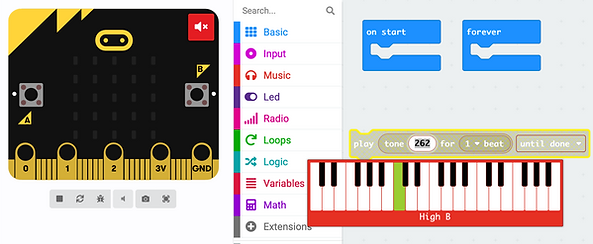
Description: KidsTeam UW came up with the idea for the piano keyboard in the coding interface. You can read all about our process here.
Representative Papers:
Yip, J.C., Sobel, K., Pitt, C., Lee, K.J., Chen, S., Nasu, K., & Pina, L. (2017). Examining adult-child interactions in participatory design. In Proceedings of the 2017 CHI Conference on Human Factors in Computing Systems (pp. 5742–5754). Association for Computing Machinery.
Misinformation Play Pack
Years: 2022 - Present
Main Collaborators: Johnny Cho, Scott DeJong, Nisha Devasia , Julie Kientz, Rachel Moran, Michele Newman, Caroline Pitt, Megan Shen, Travis Windleharth, Stacey Wedlake
Description: Synthetic media, artificial intelligence, algorithmic biases, manipulated content, disinformation operations…the contemporary information environment poses immense challenges to individuals and communities worldwide. Media and information literacy (MIL) has long been relied upon to equip people with the knowledge and skills needed to successfully and safely find, use, and create information. Yet, as critical as these skills are, practitioners and researchers have found that conventional approaches to MIL are not sufficient for facing the wave of new technologies and tactics that disrupt our information ecosystem. We design Loki’s Loop, a project of the University of Washington Center for an Informed Public. Our mission is to design games that offer experiential and social learning opportunities for building resilience and agency in today’s fractured information environment.
Representative Papers:
Yip, J.C., Newman, M., Zhao, R., Kim, D., Lim, J.R., Pedraja, M.K., Sachdeva, S., Zheng, X., Zhou, Y., Coward, C., & Lee, J.H. (2026). Rethinking misinformation: A holistic community model for youth resilience through socioemotional learning and sociocultural design. In Proceedings of the 2026 CHI Conference on Human Factors in Computing Systems.
bottom of page